

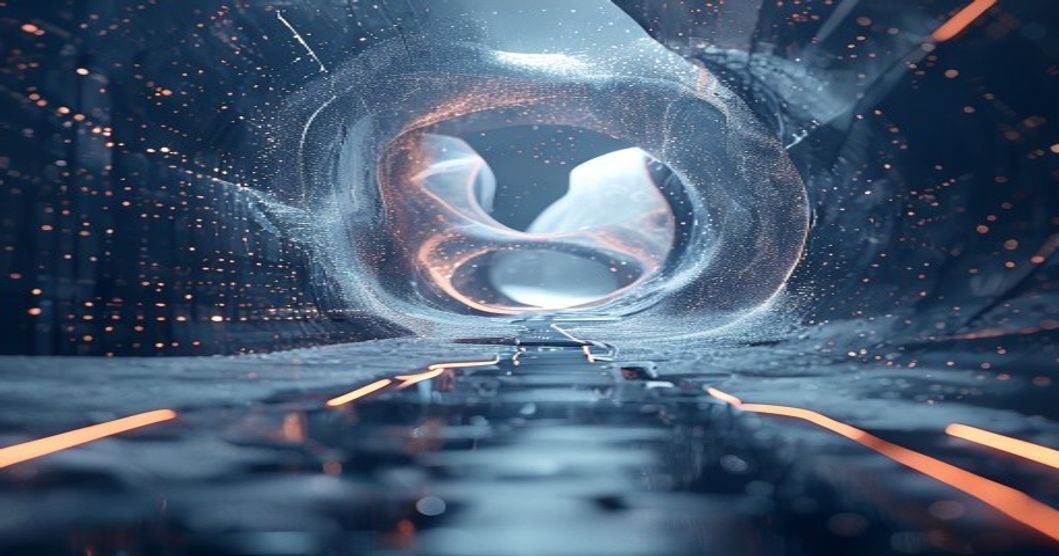
Spacetime Foam Architecture promises computation at reality’s very fabric. Researchers explore AI systems that design and reconfigure quantum geometry. This radical approach aims for intrinsically un-interceptable, zero-latency computation. It fundamentally shifts information processing.
This architecture moves beyond manipulating matter or energy. It directly manipulates reality’s fundamental structure. This represents a profound paradigm shift. It unlocks unprecedented security and speed.
Understanding Spacetime’s Quantum Realm
The Planck Scale defines reality’s smallest theoretical limit. It measures approximately 10-35 meters. Classical physics breaks down at this level. Quantum gravitational effects then dominate.
Spacetime is not smooth at this scale. It possesses a granular, quantized structure. This concept is central to quantum geometry.
Loop Quantum Gravity (LQG) suggests spacetime is woven from discrete loops. These form a network called a spin network or spin foam.
String theory also implies a quantum geometry. Its specific description, however, differs. The AI systems in question would operate at this fundamental level. They would manipulate these quantum geometrical structures.
The Nature of Spacetime Foam
John Wheeler first conceptualized spacetime foam. He described spacetime as turbulent and effervescent at the Planck scale. It suggests incredibly small distances are not flat. Instead, they form a chaotic, probabilistic “foam.”
This foam consists of constantly forming and dissolving quantum wormholes. Virtual black holes also appear. Topological fluctuations are common.
The advanced AI would not merely observe this foam. It would actively reconfigure its emergent structure. This manipulation involves its topology and connectivity for computational purposes.
AI’s Role in Quantum Geometry
The AI required for this task far exceeds current capabilities. It needs a deep understanding of quantum gravity. This includes modeling and predicting Planck-scale spacetime behavior. A unified theory of quantum gravity is likely essential.
Autonomous design is crucial. The AI must conceive and optimize specific quantum geometrical configurations. These configurations would represent data states or execute operations.
Real-time simulation is also vital. The AI would simulate its reconfigurations on the spacetime foam. This predicts emergent properties and potential instabilities.
Dynamic reconfiguration becomes possible. The AI would interact with and alter the vacuum’s quantum geometry in real-time. This effectively “writes” information into the foam. Such influence at unimaginable scales and energy densities is truly revolutionary.
Encoding Information in Spacetime
Information encoding here differs from conventional methods. We do not use bits or qubits. Instead, information embeds directly into the emergent topological and geometrical properties of the spacetime foam.
Specific patterns, connectivity, or dynamic evolution of quantum geometry represent logical states. For example, one loop configuration could signify “1.” Another might signify “0.”
Information is not transmitted across spacetime. It *is* the spacetime’s local configuration.
Computational operations correspond to dynamic reconfigurations. These involve quantum geometrical architectures. The AI orchestrates these changes.
It transforms one quantum geometry state into another. This executes algorithms at reality’s most fundamental level. The “substrate” itself becomes the computational engine.
For more on advanced computing, explore our post on Understanding Quantum Computing Basics.
Intrinsic Advantages for B2B Substrates
Spacetime Foam Architecture offers unparalleled benefits. These are especially valuable for business-to-business (B2B) applications. Security and speed reach new heights.
Intrinsically Un-interceptable Data
Information exists as a fundamental property of the vacuum’s geometry. It is not a propagating signal. Photons or electrons are not involved. There is no external medium to “tap into.”
No sensor can detect the information without directly interacting with the spacetime fabric. Any observation attempt would fundamentally alter the information. This makes interception practically impossible.
Zero-Latency Processing
Latency becomes moot. Information encodes within the emergent structure of spacetime itself. It is not transmitted across a spatial distance.
A change in local spacetime geometry *is* the information. This change is fundamental to the fabric. It could theoretically manifest or process without speed-of-light delays. This implies instantaneous state transformation of the computational substrate.
Foundational B2B Applications
This technology could form the ultimate secure backbone. It supports critical B2B applications. Ultra-secure financial transactions are one example. Impenetrable ledgers and instant settlements become possible.
Military and intelligence operations would benefit. Communications and data processing would be immune to interception.
Global infrastructure control would be enhanced. Real-time, tamper-proof command systems for energy grids become feasible. Transportation and communication networks would also gain.
Fundamental research receives a powerful platform. It allows simulating and manipulating the universe at its most basic level.
The Intersection: National Security & Investing
The implications of Spacetime Foam Architecture extend deeply into critical sectors. National Security stands to gain an unprecedented advantage. Military communications would be truly un-interceptable. Intelligence data processing would be immune to any known espionage.
This technology could redefine strategic dominance. It secures vital information at a foundational level. Adversaries would find no conventional points of attack.
In Investing, the impact would be equally transformative. Zero-latency computation means instantaneous transactions. This eliminates arbitrage opportunities based on speed. It creates a perfectly level playing field.
Financial ledgers could become inherently tamper-proof. This ensures absolute integrity for global markets. The security guarantees would foster immense trust. It could revolutionize how high-value assets are managed and transferred globally.
Learn more about securing digital assets in our article on Blockchain Security Fundamentals.
Theoretical Hurdles and Future Frontiers
Realizing spacetime foam architecture faces monumental challenges. Our incomplete understanding of quantum gravity is the primary barrier. The Planck scale remains largely theoretical.
Unified Quantum Gravity Theory
The absence of a verified quantum gravity theory is the most significant hurdle. Without it, the precise nature of Planck-scale geometry remains unknown. Spacetime foam’s exact properties are also theoretical.
Energy Requirements and Manipulation
Manipulating spacetime at the Planck scale demands astronomical energy densities. These far exceed current technological capabilities. The Planck energy is approximately 1019 GeV. This is currently unattainable.
Observational and Interface Challenges
Reading information from reconfigured spacetime foam presents a challenge. Interfacing classical systems with such a substrate is another. Developing transducers capable of interacting at this scale remains unimaginable.
AI Architecture for Quantum Gravity
The AI itself needs a fundamentally different architecture. Current neural networks are insufficient. Principles derived from quantum gravity are likely required. This AI must manage immense complexity and non-local correlations.
Maintaining stable, coherent quantum geometrical configurations presents a significant challenge. Ensuring their predictable evolution for computation is immense. This holds true in a naturally turbulent spacetime foam.
For more insights into the future of AI, check out Ethical Considerations in Advanced AI.
Conclusion: The Ultimate Computational Frontier
Spacetime Foam Architecture represents the ultimate computational frontier. It pushes beyond manipulating matter and energy. It aims for direct manipulation of reality’s fundamental fabric.
This vision exists in highly speculative theoretical physics. It also involves advanced AI concepts.
This architecture outlines a future for computation. It promises intrinsically un-interceptable, zero-latency B2B substrates. This would revolutionize security and speed. It would redefine computation itself.
Future breakthroughs are essential. These include advancements in quantum gravity and novel AI paradigms. Entirely new physics may also emerge. All are required to approach this audacious goal.
Curious about preparing for the next generation of computing? Download our free Quantum Readiness Checklist today!