

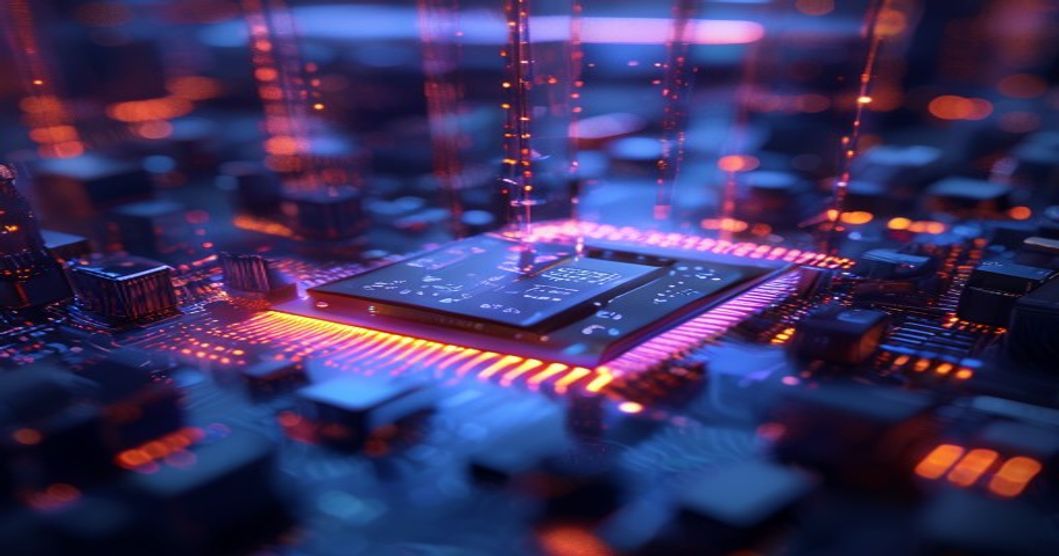
Quantum computing stands at the forefront of technological innovation. Scientists actively seek new ways to overcome the fragility of quantum information. A groundbreaking approach involves **Gain-Loss Quantum Processors**.
These systems leverage controlled energy injection and dissipation. They promise inherently more robust and self-correcting quantum computations. This paradigm shift could redefine the future of quantum technology.
What Are Non-Hermitian Quantum Processors?
Traditional quantum mechanics relies on Hermitian Hamiltonians. These conserve probability in isolated systems. Non-Hermitian systems, however, explicitly interact with their environment.
They incorporate both gain (energy injection) and loss (energy dissipation). While often seen as noise, controlled gain-loss landscapes offer significant advantages. They move beyond simple error mitigation.
These processors actively exploit dissipation and amplification. They use these as computational resources. The “topological” aspect further ensures robustness against local perturbations.
Engineering Dynamic Gain-Loss Landscapes
Creating and controlling gain-loss landscapes presents a core engineering challenge. It also offers a major opportunity. We must design circuits with precisely tunable energy injection and dissipation rates.
Implementation often uses coupled superconducting circuits. Parametric amplification introduces gain. Josephson parametric amplifiers are common examples. Loss comes from controlled coupling to dissipative reservoirs.
Resistive elements or tunable radiative decay channels also induce loss. “Dynamically reconfigurable” means changing gain and loss across the circuit during operation. This allows navigation to exceptional points (EPs) or PT-symmetry breaking.
Superconducting Circuits: The Ideal Platform
Superconducting circuits are perfect for non-Hermitian topological processors. Arrays of coupled transmons or microwave resonators serve as excellent platforms. They offer several key advantages for this technology.
First, they provide scalability. Superconducting circuits are at the forefront of building large-scale quantum processors. This is crucial for future development.
Second, they ensure coherent control. They offer excellent coherence times for individual qubits. Precise control over qubit interactions is also possible.
Third, they offer remarkable tunability. Resonant frequencies, coupling strengths, and dissipation rates are finely adjustable. External magnetic fields or control voltages facilitate this tuning.
This tunability is essential for dynamic gain-loss landscapes. It helps precisely maneuver systems to exceptional points. Active elements integrate easily into these architectures. Josephson parametric amplifiers, which provide gain, fit seamlessly.
Harnessing Exceptional Points (EPs)
Exceptional points are singularities in non-Hermitian systems. Here, eigenvalues coalesce. Their corresponding eigenvectors also become degenerate.
At an EP, the system’s response becomes highly sensitive. It also becomes non-reciprocal. Tuning the gain-loss balance or coupling strength can lead to an EP in coupled superconducting systems.
Approaching and encircling an EP induces non-trivial phenomena. This includes state transfer with enhanced efficiency or chirality. EPs offer enhanced sensitivity. Small perturbations near an EP cause large, measurable changes.
This is useful for ultra-sensitive sensing or error detection. EPs also enable unidirectional transport. Encircling an EP creates chiral or unidirectional excitation transport. This forms the basis for quantum isolators or circulators.
Leveraging PT-Symmetry Breaking
Parity-Time (PT) symmetry originates from quantum field theory. A non-Hermitian Hamiltonian can have a real spectrum. This occurs if it’s symmetric under parity (P) and time-reversal (T) operations.
In systems with balanced gain and loss, PT-symmetry can be preserved. This leads to real eigenvalues. Increasing the gain-loss contrast breaks this symmetry.
Beyond a critical threshold, the system enters a PT-broken phase. Here, eigenvalues become complex conjugates. This transition often happens at an EP. The PT-broken phase is inherently non-reciprocal.
This non-reciprocity can be harnessed to create quantum isolators or circulators. These allow information to flow unidirectionally. This protects quantum information from back-reflections and noise.
The topological nature derived from PT-symmetry breaking also offers robustness against disorder. This further enhances system reliability.
The Intersection: National Security Implications
The development of **Gain-Loss Quantum Processors** has profound national security implications. Quantum computing promises unprecedented computational power. This power could break current encryption standards.
Therefore, robust quantum processors are critical. They are vital for developing next-generation secure communication. These processors could enable unbreakable quantum cryptography.
Furthermore, they can enhance intelligence analysis capabilities. Their inherent error resilience supports secure data processing. This protects sensitive information from advanced threats.
Consequently, nations investing in this technology will gain a strategic advantage. This includes capabilities in defense, intelligence, and critical infrastructure protection. Understanding these developments is paramount for national security planning.
Benefits for Robust Quantum Computation
The integration of non-Hermitian phenomena offers compelling advantages. These enhance quantum computation significantly. First, they provide robust, unidirectional information flow.
Quantum isolators and circulators prevent destructive interference. They also block back-action from measurement and noise propagation. This significantly enhances signal integrity. It also protects delicate quantum states.
Chiral transport leads to topologically protected edge states. These are robust against local defects and disorder. This offers a pathway for robust quantum communication within the processor.
Second, these systems support self-correcting computation. The topological properties provide intrinsic protection. They guard against certain types of noise and decoherence.
This is similar to topological quantum computing. However, it may not require exotic anyons.
Enhanced sensitivity near EPs could improve error detection. The unidirectional flow simplifies error syndrome routing.
Dissipation becomes a resource, not a hindrance. Engineered dissipative pathways selectively remove unwanted states. They also prepare desired ground states more rapidly and robustly.
Challenges and Future Outlook
Despite immense promise, challenges remain. Engineering non-Hermitian topological quantum processors is complex. Precise control over gain and loss elements is technically demanding.
This is especially true in a scalable quantum system. Noise and stability are also concerns. Gain elements remain susceptible to instability. Moreover, scalability is a major hurdle.
Extending these concepts to large-scale processors requires significant engineering effort. A comprehensive theoretical framework is still developing. This framework must cover quantum computation in open, non-Hermitian topological systems.
Nevertheless, this field represents a paradigm shift. We move beyond simply mitigating noise. We actively leverage environmental interactions.
This approach offers a unique pathway. It aims for inherently more robust and potentially self-correcting quantum computers.
This paves the way for truly fault-tolerant quantum computation. For further insights into critical advancements, explore related reports on The Vantage Reports.
Read more about quantum security trends and explore the future of AI.
For deeper insights, download our “Quantum Readiness Checklist.” This resource helps organizations assess their preparedness for the quantum era.