

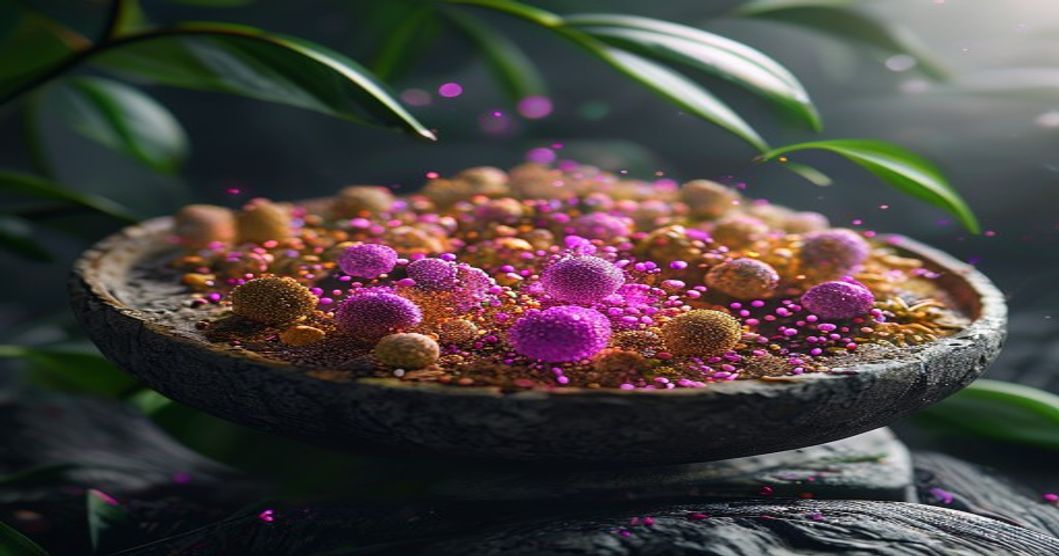
Ancient Ayurvedic practices meet modern cellular biology. Researchers are now exploring the profound impact of traditional Rasayana formulations. Specifically, they investigate how these tonics influence cellular mechanisms like Rasayana Stress Granules and proteostasis. This new frontier promises exciting discoveries for health and longevity.
Our cells constantly face stress. They possess intricate defense systems to cope. Understanding these systems offers pathways to enhanced vitality. We delve into how Rasayanas might optimize these crucial cellular processes.
Ayurveda’s Rasayana and Ojas Concepts
Ayurveda offers Rasayana therapies. These specialized treatments promote longevity and vitality. They boost immunity and overall rejuvenation. Rasayanas act as tonics, enhancing the body’s natural restorative powers.
These formulations often combine complex polyherbal, herbo-mineral, or mineral preparations. They are believed to work synergistically. This ancient wisdom suggests a holistic approach to health.
Ojas is a central Ayurvedic concept. It represents the subtle essence of all bodily tissues. Ojas embodies vitality, immunity, and cellular resilience. Healthy metabolism produces Ojas, conferring strength and disease resistance.
An “Ojas-enhancing” Rasayana boosts intrinsic cellular protective capacities. Personalized formulations are key. They tailor treatments based on an individual’s unique constitution. This ensures optimized therapeutic efficacy.
Stress Granules: Cellular Guardians Under Pressure
Stress granules (SGs) are fascinating cellular structures. They are dynamic, membraneless aggregates. SGs form rapidly in the cytoplasm. They respond to various stressors like oxidative stress or heat shock.
SGs serve as temporary storage sites. They hold untranslated mRNAs and associated proteins. Their main role is to halt non-essential protein synthesis. This redirects cellular resources towards stress response.
Critically, SGs triage mRNAs. They send them for degradation or re-initiation once stress subsides. The timely formation and resolution of SGs are paramount for cellular recovery.
However, persistent or aberrant SGs pose a problem. They are hallmarks of many proteotoxic conditions. These include neurodegenerative diseases and aging. SGs can sequester essential proteins, potentially leading to pathological aggregation.
Proteostasis: Maintaining Cellular Balance
Cellular proteostasis is a complex network. It regulates protein synthesis, folding, and degradation. This network ensures the proteome’s health and functionality. SGs are a key component of this system.
They act as an acute response mechanism. SGs maintain protein homeostasis under stress. Understanding their dynamics is crucial for cellular well-being.
Chaperone-Mediated Autophagy (CMA) Flux
Chaperone-mediated autophagy (CMA) is a selective degradation pathway. It clears specific soluble cytoplasmic proteins. Cytosolic chaperones recognize target proteins. An example is Hsc70.
These proteins then translocate across the lysosomal membrane. The LAMP2A receptor facilitates this. Subsequent degradation occurs within the lysosomal lumen. CMA is vital for cellular quality control.
CMA actively contributes to proteostasis. It removes damaged, misfolded, or excess proteins. These proteins could otherwise accumulate and become toxic. Its activity often increases during stress and aging.
However, CMA efficiency can decline with age or disease. Emerging evidence shows crosstalk between SGs and autophagy pathways. SGs can be cleared via macroautophagy. CMA may degrade specific SG components.
This prevents aggregation. Consequently, it facilitates SG resolution and overall proteostasis. Enhancing CMA could therefore offer significant health benefits.
Seeing Inside Cells: Advanced Methodologies
New technologies allow unprecedented views into cellular processes. Live-cell single-molecule imaging is one such technique. It visualizes and tracks individual molecules within living cells. This provides high spatial and temporal resolution.
This method is indispensable for observing real-time dynamics. It tracks SG assembly and disassembly. It also shows interactions with other organelles. Furthermore, it reveals the trafficking of CMA-related proteins.
This provides insights into kinetic parameters and diffusion coefficients. Bulk assays cannot achieve this level of detail. CRISPR-based reporter systems offer another powerful tool.
These genetic tools enable precise labeling of endogenous proteins or RNA molecules. They do so without overexpression artifacts. Researchers integrate fluorescent tags directly into genomic loci. Examples include SG components like G3BP1 or CMA machinery proteins like LAMP22.
This monitors their localization and dynamics. It offers a high-fidelity readout of cellular processes. These advanced methods are revolutionizing our understanding of cellular health.
How Rasayanas May Work: Modulating SGs and CMA
Personalized Rasayana formulations are hypothesized to modulate SG dynamics. This could involve preventing aberrant SG formation. They might reduce oxidative stress, inflammation, or improve mitochondrial function. These actions dampen upstream stress signals.
Rasayanas may also enhance SG resolution. They could promote efficient disassembly post-stress. This might occur by boosting ATP levels or activating disaggregases. Facilitating targeted degradation of persistent SG components via autophagy is another possibility.
Furthermore, Rasayanas may augment CMA activity. They could upregulate LAMP2A expression or stability. This increases functional CMA receptors on the lysosomal membrane. Activating cytosolic chaperones is another mechanism.
This enhances target protein recognition and delivery to lysosomes. Improving lysosomal function is also possible. This optimizes lysosomal pH and enzyme activity. The complex phytochemical profiles of Rasayanas likely exert pleiotropic effects.
They influence multiple nodes within the proteostasis network. This leads to a synergistic enhancement of cellular resilience. These formulations offer a multi-faceted approach to cellular health.
The Intersection: Daily Health and Longevity
Understanding Rasayana Stress Granules has profound implications for daily health. By optimizing cellular proteostasis, we can enhance our body’s resilience. This means a greater capacity to withstand everyday stressors.
Environmental toxins, metabolic imbalances, and aging-related damage constantly challenge our cells. Improved proteostasis bolsters the body’s intrinsic “Ojas.” This translates into better overall health, increased longevity, and stronger resistance to chronic diseases.
Imagine a future where personalized nutritional strategies, informed by ancient wisdom and modern science, help us maintain peak cellular function. This research moves us closer to such a reality. It empowers individuals to proactively support their long-term well-being.
Optimizing Cellular Proteostasis and Systemic Resilience
Precisely modulating the real-time dynamics of SGs and CMA flux offers significant benefits. Rasayana formulations are expected to optimize cellular proteostasis. They prevent the accumulation of misfolded or aggregated proteins. This maintains a healthy and functional proteome.
It also ensures efficient cellular recovery from stress. This improved cellular proteostasis enhances systemic resilience. Cells and tissues gain a greater capacity to withstand stressors. This bolsters the body’s intrinsic “Ojas.”
Consequently, it contributes to overall health and longevity. It also increases resistance to chronic diseases.
This research scientifically validates traditional Ayurvedic medicine. It uses modern molecular biology to unlock its secrets. This could lead to novel therapeutic strategies for proteostasis-related disorders.
Discover more about maintaining your cellular vitality. Download our “Cellular Resilience Blueprint” today!
For Further Reading: