

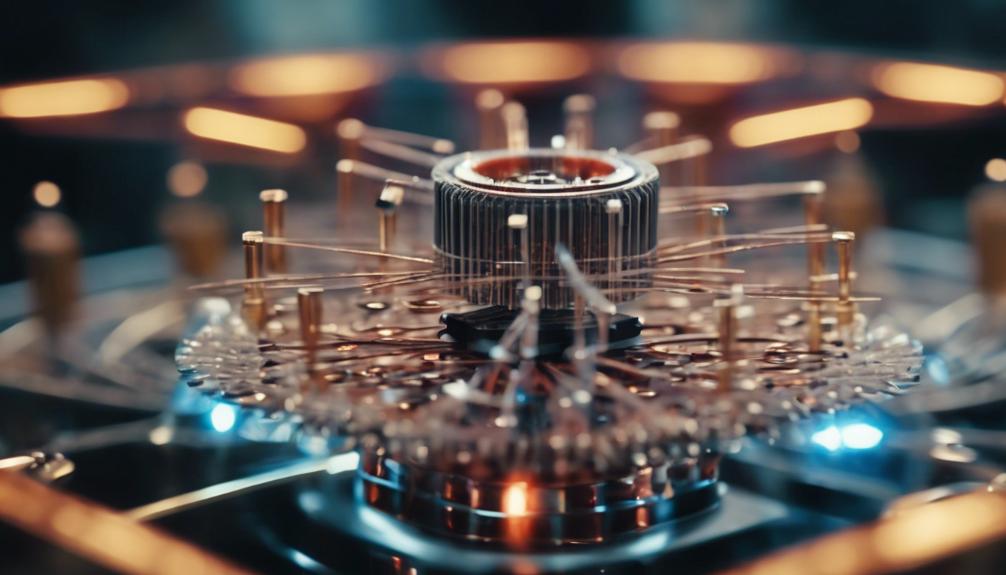
Executive Summary: Quantum-Correlated Logic (QCL) represents a revolutionary paradigm in secure networking and distributed computation, leveraging the inherent, unforgeable properties of quantum mechanics. By integrating classical logic networks with hyperentangled photon pairs, QCL offers unprecedented, information-theoretic security that bypasses traditional cryptographic vulnerabilities and significantly reduces computational overheads. This approach enables ultra-low-latency secure information transfer, making it ideal for critical infrastructure, high-frequency trading, and defense applications. While challenges remain in generating and distributing high-quality hyperentangled states, QCL promises to redefine network security by grounding protection in the fundamental laws of physics rather than computational complexity.
The advent of Quantum-Correlated Logic marks a pivotal moment in the evolution of secure, distributed computation and ultra-low-latency information transfer. This groundbreaking field is fundamentally reshaping how we conceive of network security and computational integrity, moving beyond traditional cryptographic paradigms to leverage the inherent, unforgeable properties of quantum mechanics. By integrating classical logic networks with the non-local correlations of hyperentangled photon pairs, engineers are forging a new class of systems designed for unparalleled security and efficiency, promising to revolutionize critical infrastructure, financial markets, and defense applications.
Defining Quantum-Correlated Classical Logic Networks
At its core, a quantum-correlated classical logic network represents a sophisticated hybrid paradigm. Unlike purely classical computers, which rely on bits and traditional logic gates, or nascent quantum computers, which operate on qubits for complex algorithms, these networks employ classical computational operations whose integrity and communication are intrinsically governed or enhanced by quantum phenomena. The “quantum correlation” serves as an invisible, yet incredibly robust, ‘glue’ that securely binds distributed classical components. This ensures their synchronized and trusted operation without compromising their classical processing nature. It’s an innovative architecture that skillfully harnesses quantum advantages—not for direct quantum computation—but for foundational security and communication primitives within a familiar classical computing framework. This approach offers a novel pathway to achieving information-theoretic security, where the laws of physics, rather than computational complexity, guarantee protection.
The Critical Role of Hyperentangled Photon Pairs
The foundational bedrock of these advanced networks lies in the exquisite properties of hyperentangled photon pairs. Hyperentanglement refers to a state where quantum entanglement exists simultaneously across multiple degrees of freedom (DoFs) of a photon pair, such as polarization, orbital angular momentum (OAM), time-energy, and path. For example, two photons might be entangled in both their polarization state (e.g., horizontal/vertical) and their OAM state (e.g., clockwise/counter-clockwise phase twist). This multi-dimensional entanglement significantly enhances information capacity and robustness. By leveraging multiple DoFs, more information can be encoded per photon pair, and the system gains enhanced resilience against environmental noise or various eavesdropping attempts. An eavesdropper would need to simultaneously attack multiple entangled DoFs to gain information undetected, making their task exponentially harder.
The defining feature and linchpin of these networks is the non-local correlation inherent in hyperentanglement. When two photons are hyperentangled, a measurement performed on one photon instantly influences the state of its distant partner, regardless of their spatial separation. While this doesn’t permit faster-than-light information transfer (due to the no-communication theorem), this instantaneous correlation is ingeniously exploited for the secure and rapid establishment of shared quantum states or agreements between distant nodes. For a deeper dive into the mechanics of multi-dimensional entanglement, you can explore resources on hyperentanglement on Wikipedia.
Inherent Security: Bypassing Cryptographic Overheads
The security offered by quantum-correlated networks is fundamentally distinct from traditional cryptography, often termed “inherent” or “information-theoretic.” Its guarantee stems directly from the immutable laws of quantum physics, primarily the no-cloning theorem and the measurement postulate. Any attempt by an eavesdropper (Eve) to intercept, copy, or measure the hyperentangled photons will inevitably disturb their fragile quantum state. This disturbance is not only inevitable but also detectable by the legitimate parties (Alice and Bob), immediately revealing Eve’s presence and compromising her attempt. This quantum mechanical guarantee eliminates the reliance on computationally intensive key exchange protocols (e.g., RSA, Diffie-Hellman), which are vulnerable to future advancements in computing, including the advent of large-scale quantum computers.
By establishing a shared secret or a secure channel directly through the quantum link itself, these networks bypass the need for pre-shared keys or security assumptions based on computational difficulty. This drastically reduces the computational burden associated with complex encryption/decryption algorithms, hashing, and digital signatures for core security functions, translating directly into significant efficiency gains. Furthermore, the unique quantum fingerprint of hyperentangled states can be utilized for intrinsic authentication, verifying the identity of communicating parties without relying on classical certificates or public key infrastructures. To learn more about the broader field of quantum-based security, consider exploring publications from institutions like NIST on Quantum Information Science.
Ultra-Low-Latency Information Transfer
While the no-communication theorem prevents the faster-than-light transmission of classical information, the non-local correlations of hyperentanglement enable effectively ultra-low-latency secure information transfer for specific, critical applications. The *correlation* itself is instantaneous. This allows for the rapid, secure establishment of a shared state, a cryptographic key, or a synchronized agreement between distant parties. This process circumvents the time delays typically associated with traditional network handshakes, cryptographic computations, and multiple rounds of classical communication. In scenarios demanding real-time secure decision-making or command execution, the ‘latency’ is often dominated by the computational overheads of security protocols. By bypassing these, quantum-correlated networks can achieve significantly lower effective latency for critical control signals or information flags.
This capability is particularly advantageous for distributed systems where rapid and secure consensus or synchronization is paramount. Imagine the impact on high-frequency financial trading, where microseconds can mean millions, or in industrial control systems and military command structures where immediate, trustworthy data exchange is non-negotiable. The ability to establish secure agreements almost instantaneously provides a strategic advantage, ensuring that critical information is acted upon with minimal delay and maximum integrity.
Establishing Distributed Quantum-Correlated Logic Primitives
Quantum-correlated logic networks are poised to form the fundamental building blocks for entirely new types of secure distributed computation. Consider a secure AND gate where two inputs from geographically separated locations are correlated via hyperentanglement. The output of the classical AND operation is then revealed only if the quantum correlation remains intact, ensuring the integrity and confidentiality of both the inputs and the computation itself. Furthermore, hyperentanglement facilitates advanced Quantum Secret Sharing (QSS) schemes, where a secret can be securely distributed among multiple parties such that only a predefined subset can reconstruct it, with security guaranteed by quantum physics. These networks can also provide the underlying secure communication and correlation primitives necessary for more complex Secure Multi-Party Computation (SMC) protocols, enabling multiple parties to collectively compute a function on their private inputs without revealing those inputs to each other. Beyond simple logic, hyperentanglement can secure the integrity and confidentiality of data packets, where the quantum state acts as a tamper-evident seal, providing unconditional security for transmitted information.
Engineering Challenges and Future Outlook
Despite the immense promise of quantum-correlated classical logic, significant engineering challenges remain on the path to widespread adoption. A primary hurdle is the generation and distribution of high-quality, high-rate hyperentangled photon pairs. Distributing these fragile quantum states over long distances with minimal loss and decoherence—whether via optical fibers, free-space links, or satellite networks—requires substantial technological advancements. Developing highly efficient, low-noise single-photon detectors capable of resolving multiple degrees of freedom is also crucial, as is maintaining the fidelity of hyperentanglement across the network and during interaction with classical interfaces. Seamlessly interfacing quantum components with existing classical logic circuits and network infrastructures demands sophisticated opto-electronic engineering. Moreover, scaling these networks beyond point-to-point links or small clusters of nodes necessitates breakthroughs in quantum memory, quantum repeaters, and integrated photonic circuits to overcome photon loss and enable complex network topologies. Protecting hyperentangled states from environmental noise and decoherence, especially in a distributed network setting, remains a continuous and active area of research.
Transformative Potential Applications
The unique capabilities afforded by quantum-correlated classical logic networks open doors to a range of truly transformative applications across various sectors:
- Critical Infrastructure Security: Protecting national power grids, financial transaction systems, and essential communication networks from sophisticated cyberattacks with quantum-guaranteed security.
- Distributed Secure Sensing and Control: Enhancing the integrity and trustworthiness of data from geographically dispersed sensor networks and ensuring secure, ultra-low-latency command and control in critical industrial or defense applications.
- Ultra-Secure Communication for Sensitive Data: Providing unconditionally secure channels for government, military, and financial institutions handling highly sensitive information where compromise is not an option.
- Quantum Internet Components: While not a full quantum internet, these networks could form crucial secure classical communication layers, supporting the development of a future quantum internet architecture.
- High-Frequency Trading: Offering a significant competitive edge through ultra-low-latency secure communication, ensuring rapid and tamper-proof transaction processing in time-sensitive financial markets.
Conclusion
Quantum-correlated classical logic networks represent a compelling fusion of classical computing practicality with the inherent security and efficiency offered by quantum mechanics. By ingeniously harnessing hyperentangled photon pairs, this paradigm offers a robust and intrinsically secure pathway towards distributed computational primitives and ultra-low-latency information transfer. This innovative approach is poised to redefine the landscape of secure communication and distributed computing, providing solutions that are not merely computationally difficult to break, but fundamentally impossible to compromise without detection, rooted in the very laws of physics. The future of secure networking is undoubtedly quantum-enhanced.
Explore The Vantage Reports for more insights into cutting-edge technologies.