

Executive Summary: The cutting-edge frontier of quantum computing is currently being redefined by the groundbreaking advancements in Continuous-Variable QNN, or Continuous-Variable Quantum Neural Networks, which are spearheading a paradigm shift towards ultra-fast, fault-tolerant analog quantum computation. Moving beyond the binary constraints of discrete qubits, CVQNNs leverage the rich, infinite-dimensional Hilbert spaces of bosonic modes—such as photons or phonons—to offer a powerful new approach to quantum information processing. This report delves into the foundational principles, engineering challenges, and transformative applications of these revolutionary networks, highlighting their potential to transcend the inherent limitations of traditional quantum architectures and unlock unprecedented capabilities in complex optimization and machine learning tasks.
1. Foundations of Continuous-Variable Quantum Neural Networks (CVQNNs)
At its core, a CVQNN is a quantum machine learning model built upon continuous variables, primarily the quadratures of bosonic modes. Unlike discrete qubits, which fundamentally operate on a two-level system (0 or 1), CV systems allow for an unbroken spectrum of values. This continuous range enables a significantly richer information encoding capacity per quantum mode, laying the groundwork for more complex and nuanced quantum algorithms.
Bosonic Modes: The Physical Substrate
- Photons: Optical platforms are a leading candidate for CVQNN implementation. Here, light modes are manipulated using components like beam splitters, phase shifters, and squeezers. The development of integrated photonic circuits is crucial for scaling these systems, allowing for the fabrication of complex interferometric networks on a single chip, minimizing environmental decoherence.
- Phonons: These vibrational quanta in a crystal lattice offer another promising avenue. Phononic CVQNNs can be realized in platforms such as superconducting circuits coupled to mechanical resonators or in optomechanical systems, where light and mechanical motion interact. These systems aim to harness the robust coherence and strong coupling properties of phonons.
Highly Entangled and Squeezed States: Essential Quantum Resources
The true power of CVQNNs lies in their ability to generate and manipulate highly non-classical quantum states:
- Squeezed States: These are quantum states where the noise in one observable (e.g., position quadrature) is reduced below the standard quantum limit, at the expense of increased noise in its conjugate observable (e.g., momentum quadrature). This “squeezing” is a vital resource, enhancing the sensitivity of quantum metrology and providing the non-classicality required for quantum computational advantage.
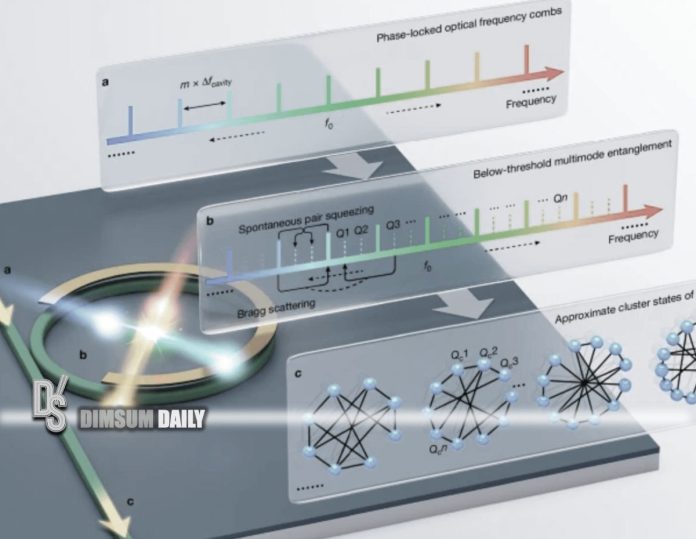
- Entangled States: Multipartite quantum states where the properties of individual bosonic modes are correlated in ways impossible classically. Cluster states, for instance, are a class of highly entangled states often utilized as a resource for measurement-based quantum computation within the CV framework, providing the intricate correlations necessary for complex quantum operations.
2. Analog Quantum Computation with CVQNNs
CVQNNs inherently perform computation in an analog fashion, where operations act directly on the continuous values of the quantum states rather than discrete bit flips. This approach holds significant promise for tasks that naturally involve continuous parameters.
Gate Set for Continuous Variables
The fundamental operations in CV quantum computation are typically categorized as:
- Gaussian Operations: These include displacements, rotations, squeezers, and beam splitters. They are relatively easy to implement experimentally and preserve the Gaussian nature of the input states. While powerful, Gaussian operations alone are not sufficient for universal quantum computation.
- Non-Gaussian Operations: These are critical for achieving universal quantum computation and generating highly non-classical states. Examples include cubic phase gates and Kerr interactions. Implementing these gates remains a significant experimental challenge, often requiring photon addition/subtraction or interactions with nonlinear media.
Advantages over Discrete Qubits
The CV approach offers distinct benefits:
- Higher Information Density: Continuous variables can encode substantially more information per mode than a single qubit, potentially leading to more compact representations of complex problems.
- Natural Fit for Optimization & ML: Many real-world optimization and machine learning problems inherently involve continuous parameters, making CVQNNs a more natural and potentially more efficient fit for their quantum counterparts.
- Reduced Overhead for Specific Tasks: For problems like simulating bosonic systems or solving certain differential equations, CV systems can provide a more direct and efficient mapping, potentially reducing the resource overhead compared to discretizing such problems for qubit-based architectures.
3. Engineering Challenges and Approaches for Continuous-Variable QNN
Developing robust and scalable CVQNNs demands sophisticated engineering of quantum hardware and precise control mechanisms. The challenges vary depending on the chosen physical platform.
Optical Platforms (Photons)
- Quantum Light Sources: Generating high-purity, high-squeezing factor squeezed vacuum states and entangled states (e.g., through spontaneous parametric down-conversion or four-wave mixing) is paramount.
- Integrated Photonics: The development of on-chip waveguides, beam splitters, phase shifters, and detectors is vital for creating scalable and stable interferometric circuits. This approach minimizes environmental decoherence and enables complex network architectures, paving the way for practical integrated quantum photonics.
- Homodyne Detection: A key measurement technique in CV quantum optics, homodyne detection allows for the precise measurement of specific quadratures of light, which is crucial for readout and implementing measurement-based quantum computation.
- Non-Gaussian Operations: As noted, implementing non-Gaussian gates remains a significant hurdle. Current approaches often involve the probabilistic addition or subtraction of single photons or the use of ancillary qubits interacting with nonlinear optical elements.
Phononic Platforms
- Superconducting Circuits: Coupling superconducting qubits or resonators to mechanical resonators allows for the manipulation of phonons, offering strong coupling and promising coherence properties for quantum information processing.
- Optomechanics: This field uses the interaction between light and mechanical motion to generate and control phononic states. Optomechanical systems can also mediate interactions, making them candidates for hybrid quantum computing architectures.
- Cryogenic Environments: Both photonic and phononic systems often necessitate ultra-low temperatures (millikelvin range) to minimize thermal noise and preserve the fragile quantum coherence of the continuous variables.
4. Ultra-fast and Fault-Tolerant Computation
The promise of CVQNNs extends to achieving both ultra-fast and fault-tolerant quantum computation, addressing two of the most critical requirements for practical quantum technologies.
Ultra-fast Potential
- Light-Speed Operations: In optical platforms, quantum operations inherently occur at the speed of light. Once quantum states are generated and properly manipulated, this offers an intrinsic speed advantage for information processing.
- Parallel Processing: The inherent parallelism of quantum mechanics, combined with the ability to process continuous information, can lead to faster convergence for certain algorithms, particularly those involving high-dimensional data or complex optimization landscapes.
Fault Tolerance in CV Systems
Achieving fault tolerance in CV systems is distinct from discrete qubit error correction and presents unique challenges and opportunities.
- Gaussian Quantum Error Correction: While Gaussian operations themselves don’t directly correct errors, they can be part of error detection schemes. More advanced techniques are needed for full fault tolerance.
- Gottesman-Kitaev-Preskill (GKP) States: These are specific non-Gaussian bosonic states that encode a qubit within a continuous variable, offering a promising pathway to fault-tolerant quantum computation by effectively discretizing continuous errors. Generating and stabilizing GKP states, while a major experimental challenge, offers a robust route to quantum error correction in CV systems. Recent advancements in this area are pushing the boundaries of what’s possible in fault-tolerant quantum computing with continuous variables, as detailed in various research, including comprehensive reviews on quantum error correction for CV systems.
- Hybrid Architectures: Combining the strengths of CV systems with discrete qubits could offer a synergistic approach. CV systems could handle specific computational tasks where they excel, while discrete qubits provide robust error correction for the entire system.
5. Applications: Optimization and Machine Learning
The unique capabilities of Continuous-Variable QNNs make them particularly well-suited for a range of computationally intensive problems, especially in optimization and machine learning.
Complex Optimization
- Variational Quantum Eigensolvers (VQE): Adapting VQE algorithms for CV systems allows for the efficient finding of ground states of molecules or materials, crucial for quantum chemistry and materials science.
- Quantum Approximate Optimization Algorithm (QAOA): Implementing QAOA variants for continuous optimization problems, such as energy minimization in continuous landscapes, can provide quantum speedups for complex industrial problems.
- Solving Differential Equations: CV systems can naturally represent continuous functions and their derivatives, making them powerful tools for solving differential equations relevant in physics, engineering, and finance.
Machine Learning with CVQNNs
- Quantum Neural Networks: CVQNNs can act as powerful quantum layers within hybrid classical-quantum machine learning models, performing tasks like pattern recognition, classification, and regression on complex, high-dimensional datasets. Their continuous nature allows for richer feature mapping.
- Quantum Generative Models: Leveraging the ability of CV systems to represent and sample from complex probability distributions, they can be used for generative tasks, potentially outperforming classical generative adversarial networks in certain scenarios.
- Data Encoding: The rich state space of CV systems allows for sophisticated encoding of classical data into quantum states, potentially enhancing the expressive power and learning capacity of machine learning models.
6. Transcending Discrete Qubit Limitations
The continuous-variable approach offers several compelling advantages over the conventional discrete qubit model, particularly in terms of scalability and suitability for specific problem domains. This makes CVQNNs a vital alternative in the quest for practical quantum advantage.
- Resource Efficiency: For certain problems, CV systems may require fewer physical modes to achieve a quantum advantage compared to discrete qubits, which might need many qubits to encode continuous-valued information with sufficient precision.
- Natural Problem Mapping: Problems that are inherently continuous in nature—such as simulating wave phenomena, continuous optimization, or certain types of signal processing—can be mapped more directly and efficiently onto CV systems, leading to more intuitive algorithm design and potentially better performance.
- Alternative Path to Fault Tolerance: While challenging, the GKP state approach provides a distinct and potentially more robust path to fault tolerance against certain types of noise prevalent in bosonic systems. This could complement or even surpass qubit-based error correction for specific applications, offering a diverse toolkit for building resilient quantum computers.
- Scalability: Integrated photonic circuits, a key platform for CVQNNs, offer a promising route to scalability by leveraging mature semiconductor fabrication techniques. This could allow for the creation of large-scale, stable, and complex CVQNNs in a compact form factor.
For more in-depth analyses and cutting-edge research in quantum computing, you might want to Explore The Vantage Reports.
Conclusion
The engineering of Continuous-Variable QNN represents a cutting-edge and increasingly vital frontier in quantum information science. By harnessing the unique and powerful properties of highly entangled and squeezed bosonic modes, CVQNNs offer a robust and versatile platform for ultra-fast, fault-tolerant analog quantum computation. This paradigm shift holds immense promise for tackling complex optimization and machine learning challenges that currently lie beyond the capabilities of both classical supercomputers and nascent discrete qubit technologies. As research progresses in generating stable GKP states, developing integrated photonic circuits, and refining non-Gaussian operations, CVQNNs are poised to deliver a new era of quantum advantage, fundamentally reshaping our approach to some of the most demanding computational problems across science and industry.