

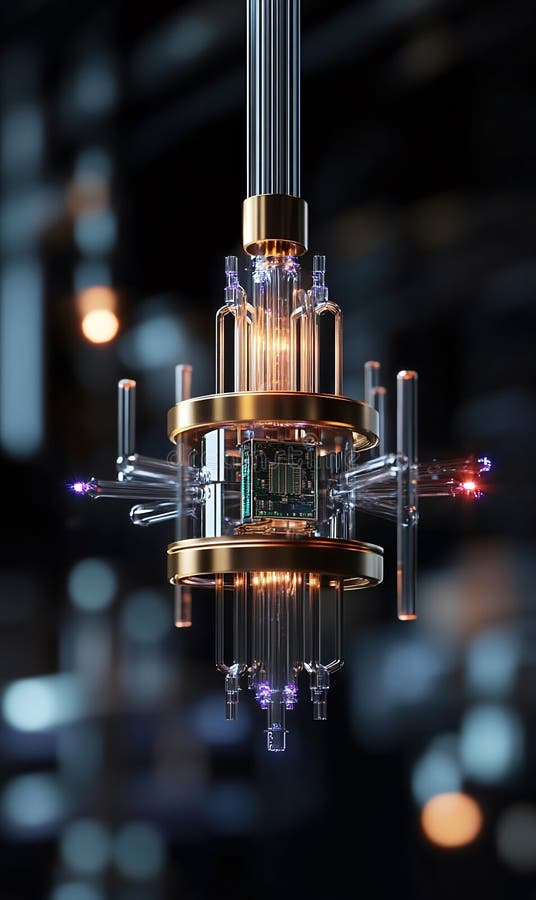
Executive Summary: Superfluidic Processors represent a groundbreaking frontier in quantum computation, harnessing the unique properties of Bose-Einstein Condensates (BECs) to redefine energy efficiency and quantum coherence. Unlike conventional quantum computing architectures that grapple with the persistent challenges of thermal noise and environmental decoherence, these novel systems leverage the macroscopic quantum coherence and frictionless flow inherent to BECs. This approach promises an ultra-low energy computational platform that is intrinsically more robust against quantum information loss, paving the way for a new generation of powerful and stable quantum machines. Our exploration delves into the fundamental engineering principles, unparalleled advantages, and the transformative potential of this cutting-edge technology.
The Foundational Role of Bose-Einstein Condensates (BECs)
At the heart of superfluidic quantum processors lies the Bose-Einstein Condensate, an exotic state of matter formed when a gas of bosons is cooled to temperatures just a few billionths of a degree above absolute zero. At such extreme conditions, a significant fraction of the atoms occupies the lowest possible quantum state, causing their individual wave functions to overlap and merge. This macroscopic quantum phenomenon is not merely a scientific curiosity but a cornerstone for advanced quantum computation, offering two critical properties:
1. Macroscopic Quantum Coherence
In a BEC, the atoms cease to behave as independent particles and instead synchronize their quantum states, effectively forming a single, giant “super-atom” governed by a collective wave function. This macroscopic coherence is paramount for quantum computing, as it allows for the definition of robust qubits and the maintenance of entanglement across a larger system, transcending the limitations of individual, isolated quantum systems. The coherence time in BECs can be significantly longer than in many other quantum computing architectures, offering a naturally stable environment for complex quantum operations without the rapid loss of delicate quantum information. This collective behavior inherently protects the quantum state from localized disturbances, distributing information across the entire ensemble rather than confining it to a single, vulnerable particle.
2. Frictionless Flow (Superfluidity)
A hallmark characteristic of BECs, particularly those composed of bosonic atoms, is superfluidity – the ability to flow without any viscosity or friction. This property holds profound implications for energy efficiency in a computational context. Operations performed on or within a superfluidic medium, such as the manipulation of quantum information encoded in collective excitations or the transport of BEC segments, would, in principle, require minimal energy dissipation. The absence of resistive forces means that maintaining quantum states or executing quantum gates can occur with virtually no energy loss, directly contributing to the promise of “ultra-low energy computation.” This frictionless nature is a radical departure from classical computing, where heat dissipation is a primary bottleneck, and even from other quantum architectures that still contend with residual thermal noise.
Engineering Superfluidic Processors: Core Principles
The journey to building functional superfluidic quantum processors involves a sophisticated interplay of physics and engineering. It entails the precise creation, trapping, manipulation, and ultimately, the readout of quantum information encoded within these ultra-cold quantum systems.
BEC Generation and Trapping
The first step involves creating the BEC itself. Atoms, commonly isotopes like Rubidium-87, Sodium-23, or Lithium-7, are initially cooled using a combination of laser cooling techniques (Doppler and Sisyphus cooling) down to microkelvin temperatures. This process slows the atoms considerably. Subsequently, evaporative cooling is employed, where the hottest atoms are selectively removed from a magnetic or optical trap. This allows the remaining atoms to thermalize at an even lower temperature, eventually reaching the nanokelvin regime where BEC formation occurs. Once formed, BECs are precisely held and controlled by highly stable magnetic fields, often generated by Ioffe-Pritchard traps or intricate atom chips, or by optical dipole traps created by tightly focused laser beams. Furthermore, optical lattices – periodic potential landscapes formed by interfering laser beams – can trap individual atoms or small BECs at each lattice site, effectively serving as configurable qubit registers.
Encoding Quantum Information (Qubits)
The method of encoding qubits in superfluidic systems is diverse and highly adaptable:
- Internal States of Atoms: Qubits can be encoded in the internal quantum states of the atoms within the BEC, such as two distinct hyperfine or Zeeman states representing the |0⟩ and |1⟩ computational basis states.
- Spatial Modes/Collective Excitations: Alternatively, quantum information can be encoded in collective excitations or specific spatial modes of the BEC itself. Examples include phonons (quantized sound waves) or solitons (self-reinforcing solitary waves). The macroscopic and coherent nature of the BEC allows for robust encoding across a vast number of particles, offering intrinsic protection against localized errors.
- Superfluid Circuits/Interferometers: Drawing parallels with superconducting circuits, “superfluid circuits” can be engineered. Quantized vortices, persistent currents within the BEC, or even the interference patterns of BECs in atom interferometers can represent computational states, potentially forming qubits or arrays of qubits that exploit the wave-like properties of the condensate.
Quantum Gates and Operations
Executing quantum gates in superfluidic processors requires exquisite control over atomic interactions:
- Laser-Mediated Interactions: Precisely tuned laser pulses are instrumental in inducing transitions between atomic states or manipulating the spatial configuration of the BEC. For instance, Raman transitions can coherently couple different hyperfine states, enabling single-qubit rotations and multi-qubit entanglement operations.
- Controlled Collisions: Within BECs, atoms naturally interact via collisions. These interactions can be finely modulated using external optical or magnetic fields to generate entanglement between qubits encoded in nearby BECs or within different regions of a single, larger BEC.
- Optical Lattices for Entanglement: By dynamically controlling the depth, spacing, and geometry of optical lattices, researchers can precisely bring atoms together to interact, perform a desired gate operation, and then separate them. This mechanism is crucial for implementing two-qubit gates, a fundamental requirement for universal quantum computation.
Readout Mechanisms
Extracting the computational result from a superfluidic processor demands state-of-the-art detection techniques:
- State-Selective Ionization/Fluorescence: Qubit states can be read out by selectively ionizing atoms in a particular quantum state or by detecting state-dependent fluorescence using resonant lasers. This allows for discrimination between |0⟩ and |1⟩ states.
- Absorption Imaging: This widely used technique involves shining a precisely tuned laser beam through the BEC and observing the shadow cast by the atoms. By tuning the laser to be resonant with a specific atomic transition, the density distribution of atoms in a particular quantum state can be spatially resolved with high precision, providing a direct measurement of the qubit state.
Unlocking Advantages: Ultra-Low Energy and Inherent Decoherence Resistance
The unique physical properties of BECs translate into two profound advantages for quantum computing:
1. Ultra-Low Energy Computation
The prospect of ultra-low energy computation is one of the most compelling aspects of superfluidic processors. The frictionless dynamics of a superfluid mean that the transport and manipulation of quantum information, whether through collective excitations or the physical movement of BEC segments, occurs with virtually no energy dissipation. This drastically reduces the energetic cost of computation compared to classical computers, which are plagued by resistive forces and heat generation, and even other quantum architectures that still contend with residual energy losses. Furthermore, the intrinsic macroscopic coherence of a BEC contributes to passive coherence maintenance. Unlike systems that demand constant active cooling or complex error correction protocols to combat environmental noise, the BEC provides a naturally stable quantum environment, significantly lowering the energy overhead associated with preserving quantum states over extended periods.
2. Inherent Decoherence Resistance
Decoherence, the bane of quantum computing, typically arises from the interaction of a quantum system with its environment, leading to the rapid loss of superposition and entanglement. Superfluidic processors offer a powerful counter to this challenge due to their collective nature. Quantum information is not localized to a single, fragile particle but is distributed across the entire coherent ensemble of the BEC. This collective encoding makes the system significantly more robust against localized perturbations or interactions with stray environmental particles. A single “hit” or minor environmental fluctuation is less likely to collapse the entire collective state, offering a form of distributed error protection. Some theoretical models even suggest that the superfluidic gap – the energy required to create an elementary excitation – can provide a form of topological protection against certain types of decoherence, akin to proposals in topological quantum computing. Moreover, the extremely low temperatures required for BEC formation inherently minimize thermal noise and drastically reduce collisions with background gas atoms, further contributing to an isolated and stable quantum environment. For more in-depth information on Bose-Einstein Condensates, you can visit NIST’s page on BECs.
Challenges and the Future Outlook for Superfluidic Processors
Despite their extraordinary promise, the realization of large-scale, fault-tolerant superfluidic processors faces significant engineering and scientific hurdles:
- Scalability: Creating and controlling large, complex arrays of BECs or a single expansive BEC with many individually addressable qubits remains a major hurdle. Maintaining coherence and precise control across numerous interacting BEC qubits without cross-talk is exceptionally difficult.
- Temperature Requirements: The prerequisite of nanokelvin temperatures necessitates incredibly complex, expensive, and bulky cryogenic infrastructure, which currently limits practical deployment outside of specialized research laboratories.
- Control Complexity: The precise manipulation of BECs using finely tuned laser and magnetic fields demands sophisticated control systems and highly stable experimental environments, pushing the boundaries of current technological capabilities.
- Error Correction: While inherently more robust against certain forms of decoherence, BEC systems are not immune to all types of errors. Developing robust quantum error correction schemes specifically tailored for this unique architecture will be essential for achieving true fault-tolerant quantum computing.
Nevertheless, the unique advantages of ultra-low energy consumption and intrinsic decoherence resistance position superfluidic processors as a compelling and potentially transformative avenue for future quantum computation. Ongoing research is intensely focused on developing miniaturized BEC chip traps, exploring novel encoding schemes that leverage the full potential of collective excitations, and integrating these systems with photonic interfaces for scalable readout and networking. The long-term vision is a quantum computer that operates with unprecedented energy efficiency and robustness, potentially unlocking solutions to problems currently intractable for even the most powerful supercomputers, from drug discovery to advanced material science. To understand the broader landscape of quantum computing, delve into the various approaches at IBM Quantum’s overview. For more detailed analysis and reports, you can always Explore The Vantage Reports.
Conclusion
The journey towards practical quantum computation is multifaceted, with various architectures vying for dominance. Among these, superfluidic processors stand out due to their elegant solution to two of quantum computing’s most formidable challenges: energy consumption and decoherence. By leveraging the macroscopic quantum phenomena of Bose-Einstein Condensates, these systems offer a pathway to quantum computers that are not only powerful but also inherently stable and astonishingly efficient. While significant engineering and scientific challenges lie ahead, the potential for superfluidic processors to revolutionize fields ranging from fundamental physics to complex industrial applications is immense. The continued advancements in ultra-cold atom physics and precision control promise to bring this revolutionary technology closer to reality, marking a new era in the quest for quantum supremacy.